

Poultry manure technology: an enclosed housefly bioreactor
Imago Engineering uses a controlled modular process based on Housefly larvae bioconversion to turn poultry manure into marketable protein and organic fertilizer at industrial speed.
- Input
- Poultry manure
- Cycle time
- 4 days
- Outputs
- Protein + fertilizer
- System type
- Enclosed modular bioreactor
- Deployment
- On-site at poultry farm
A poultry manure technology built on an enclosed loop
The Imago process is built around a closed-loop production logic in which fresh poultry manure is processed in a controlled environment using a selected Housefly population. The system is designed for speed, scalability, biosecurity, and industrial deployment. We have solutions for farms of all sizes above 10,000 poultry heads.
Insect bioreactor technology, stage by stage
From on-farm manure collection to finished protein and granulated fertilizer, every stage runs inside a controlled, modular system.
- 1
Poultry farm manure collection
- 2
Input balancing / substrate preparation
- 3
Enclosed bioreactor stage
- 4
Larva conversion
- 5
Separation of larvae from fertilizer mix
- 6
Insectarium cycle
A controlled colony produces eggs fed into the bioreactor.
- 7
Protein output
- 8
Granulated organic fertilizer output
Core poultry manure technology components
The plant is assembled from a defined set of modular subsystems, each engineered for a distinct stage of the conversion process.
Why Housefly (Musca domestica)
Imago Engineering is built around Housefly-based bioconversion because of its rapid processing cycle, suitability for poultry manure as feedstock, and industrial efficiency under controlled conditions.
- Growth rate
- Fastest - 4 days
- Raw material
- Poultry manure
- Technology format
- Bioreactor
- Crude protein in meal
- 55–67%
- Feed application
- Poultry, aquaculture (B2B)
- Scalability
- One poultry farm, one insect plant
- Protein meal price
- $500–1,500/ton
- CAPEX per 1 ton protein
- $2,000–3,000
- Growth rate
- Slow (7–18 days)
- Raw material
- Food waste
- Technology format
- Trays
- Crude protein in meal
- 40–50%
- Feed application
- Pets (B2C)
- Scalability
- Needs many smaller producers
- Protein meal price
- $2,000–4,000/ton
- CAPEX per 1 ton protein
- $6,000–9,000
- Growth rate
- Very slow (40–60 days)
- Raw material
- Purchased raw materials
- Technology format
- Trays
- Crude protein in meal
- 50–55%
- Feed application
- Human (B2C)
- Scalability
- Too expensive
- Protein meal price
- $5,000–6,000/ton
- CAPEX per 1 ton protein
- $12,000–20,000
Insects as feed and organic fertilizer are recognised by the UN Food and Agriculture Organization as a route to more circular livestock systems.
Our poultry waste technology advantages
A flat, non-exhaustive list of the operational, environmental and commercial advantages the technology is engineered to deliver.
IMAGO Technology vs traditional solutions
Against every other poultry-manure processing method, the housefly bioreactor wins on processing time, revenue per ton and scalability.
- Processing time
- 4 days
- Products
- Protein, Organic Fertilizer
- Cost / wet ton
- $122
- Energy kWh / ton
- 260
- Space m² (400k birds)
- 2,500
- Revenue / wet ton
- $291
Poultry Manure Technology at IMAGO Engineering centers on an enclosed insect bioreactor that runs on the housefly, Musca domestica. This poultry waste technology completes a full manure-to-protein cycle in 4 days, yielding 55–67% crude protein insect meal plus granulated organic fertilizer. Housefly bioconversion replaces slow composting with a modular, automation-ready system. It consumes much less electricity than pyrolysis and as such has much better scalability and an unbeatable financial performance.
Insect bioreactor technology deployment formats
Two modular formats scale the technology from pilot validation to full industrial production.
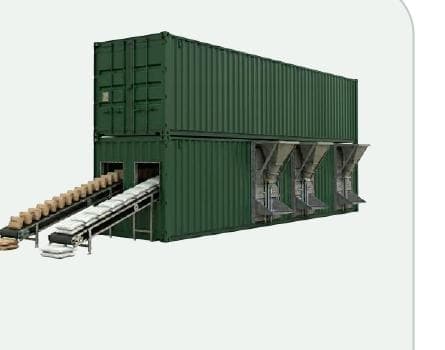
Container Unit
Pilot / small-scale validation
- Pilot deployment; smaller sites
- Testing feasibility and product quality
- Capacity
- 41 tons/month
- Estimated ROI
- 2.5–3 years
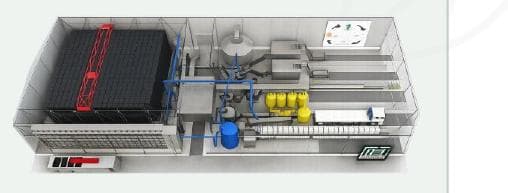
Production Plant
Poultry farms above 50,000 birds
- Modular bioreactor architecture
- Scalable layout
- Capacity
- 1-7K tons/month
- Estimated ROI
- 2.5–4 years
Sustainable agriculture solutions, in engineering-credible terms
The same enclosed, modular process turns poultry manure into productive circular value: Environmental, Social and Governance gains, every one either backed by a figure or explicitly framed as a feasibility-study output.
Environmental
- Reduced land pollution from unmanaged manure stockpiles
- Lower odor exposure
- Enclosed process design
- Better use of organic nutrient streams
- Potential contribution to lower emissions intensity versus unmanaged accumulation
Social
- Cleaner farm surroundings
- Less nuisance for nearby communities
- More structured sanitary management
- Industrial jobs in circular agri-processing
Governance
- Controlled industrial workflow
- Modular process documentation
- Measurable throughput
- Auditable production logic
- Potential for remote monitoring and reporting
A closed loop that pays for itself
Turning poultry waste into high-value insect protein and organic fertilizer, sequestering emissions and transforming a 2% global GHG problem into a sustainable profit engine.
- Poultry Farm: Daily, uninterrupted manure collection.
- Manure: Complimentary raw material · no delivery costs.
- Insect Plant: Zero emissions · zero waste · fully automated.
- Protein: High crude content · high digestibility · long shelf-life.
- Animal Feed: Aquaculture · pork industry · pets.
- Poultry Industry: The loop returns to its source.
Side products: organic fertilizer and ammonia water, complementary inputs for soil fertilization.
Insect-plant benefits
- Zero emissions
- Zero waste
- Fully automated system
- Cost-effective technology
Loop stage 03 / 6
Insect Plant
Zero emissions · zero waste · fully automated.
Additional benefits for the poultry farm
Most efficient waste recycling solution
Increasing the value of organic fertilizer
Retaining customers for organic fertilizer
Freeing up significant space for waste management
Obtaining additional, more valuable products
Reducing the number of insects on a poultry farm
Metrics we can assess during feasibility study
- Manure throughput
- Land-use reduction vs current practice
- Potential product output
- Process footprint
- Operational integration indicators
Frequently asked questions about IMAGO Poultry Manure Technology
It's an enclosed insect bioreactor that uses the housefly, Musca domestica, to convert manure into protein and fertilizer. This poultry waste technology is modular, patented and automation-ready.